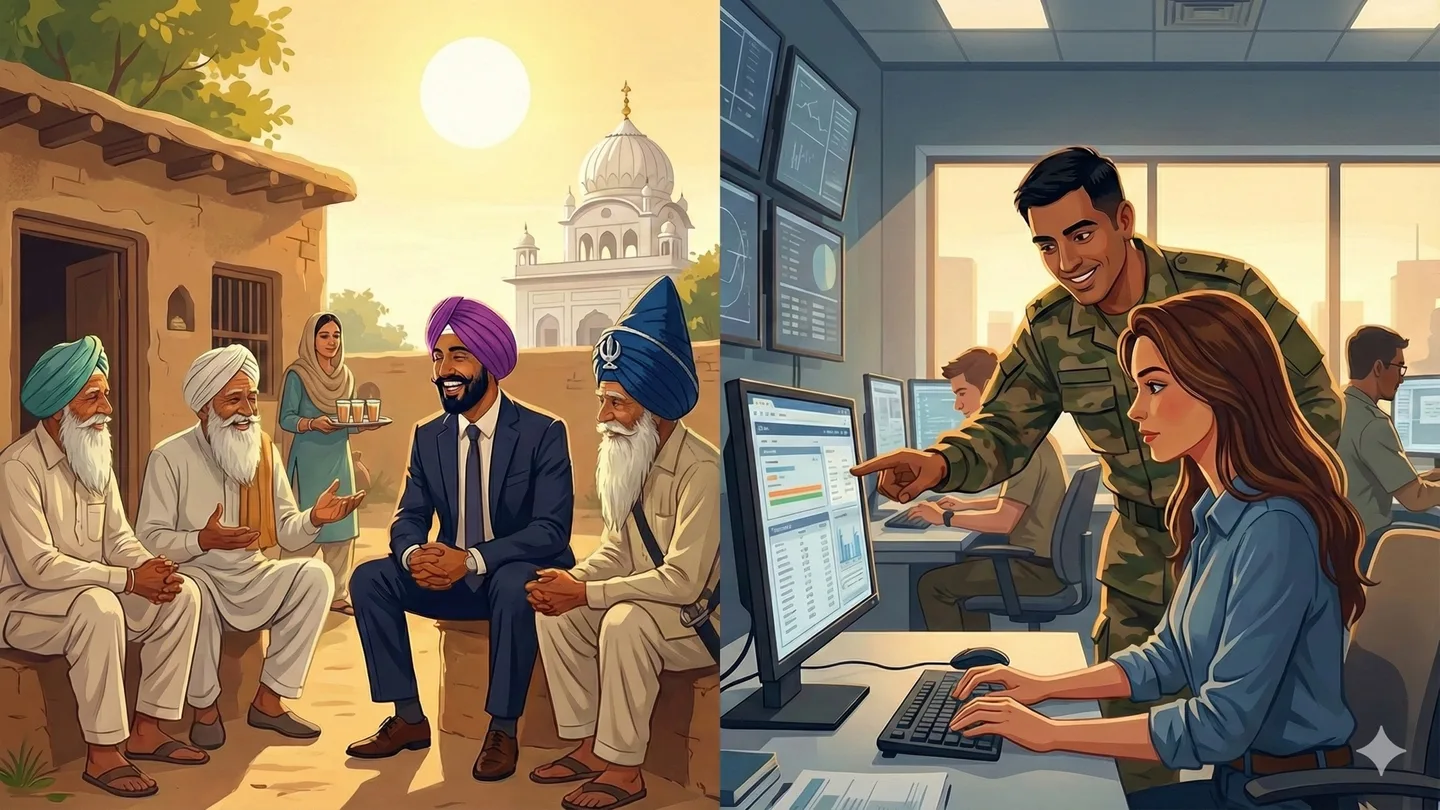
The Echo Chamber
A few weeks ago, I found myself back in rural Punjab—no notifications, no signal towers, no late-night tweets about GPT-5 updates. The hum of the algorithmic age was absent, replaced by the call of early morning tractors and Gurudwara hymns.
For the first few days, the disconnection felt like withdrawal. But slowly, the anxiety about missing out on model updates or blockchain breakthroughs faded. I met friends who never left their ancestral farms. Not one mentioned AI. They built businesses—dairies, agro-supply services—thriving not because of AI, but despite it. They didn't fear disruption; they built parallel lives of dignity.
It made me pause: Is the "AI Revolution" truly global? Or is it merely a sliver—an elite echo chamber inflating technology into a self-fulfilling prophecy? A feedback loop where corporate incentives and VC hype blur the line between innovation and ideology.
From Silence to Siren
But while the farm ignored the algorithm, the algorithm did not ignore the world. Leaving the quiet resilience of Punjab, I landed in a reality where AI was not a buzzword, but a weapon.
Last Sunday, I walked through downtown Doha, Qatar—hours before its skies were emptied. As geopolitical tensions escalated between Iran, Israel, and the U.S., flights were grounded.
And at the center of the escalation was AI.
The Ethics of Calculation
Palantir's multi-billion dollar contract with the Pentagon speaks volumes. Precision-targeting, predictive deployment, autonomous surveillance—this is the new frontier. Estimates suggest over $500 billion will flow toward defense systems, even as poverty rates stagnate.
While AI promises "precision," recent conflicts have been anything but surgical. Civilian tolls rise while human accountability thins. Precision is meaningless when strategy lacks compassion. Algorithms don't grieve. Machines don't ask whether a war should be fought—they only calculate how best to fight it.
The Human Condition
"The conversations about "ethical AI" feel eerily quiet in moments like these. We debate bias in chatbots while ignoring the bias in bombs."
If AI is to reshape the human condition, we must look at both the farm and the frontline and ask: what kind of humans are we becoming?